Your Supply Chain Just Became a Compliance Liability
A shipping container that left Shenzhen in March and arrived in Los Angeles via Tijuana in May, carrying lithium-ion battery cells labeled "assembled in Mexico," just triggered an algorithmic flag at U.S. Customs. The weight-to-value ratio is off. The transit time is too short for meaningful assembly. Mexico's semiconductor imports from China spiked 340% in the twelve months prior, while its battery exports to the U.S. rose by nearly the same margin. The algorithm doesn't care about the certificate of origin. It knows what a shell game looks like.
This is the new enforcement reality. The U.S. has moved from reactive tariff audits to proactive, AI-driven screening at the point of entry. The system isn't looking for paperwork errors. It's hunting structural patterns: shipment durations that don't align with claimed assembly work, value-added claims that exceed a country's actual industrial capacity, and trade flows through jurisdictions that became export hubs the moment Section 301 tariffs kicked in.
The Transshipment Target
The focus is a practice called transshipment, goods that originate in China, pass through a third country for minimal processing, and enter the U.S. with a new country-of-origin label to dodge tariffs ranging from 25% to 100%. Vietnam and Mexico are the two loudest signals in the dataset. Both countries have seen Chinese intermediate imports and U.S.-bound exports rise in near-lockstep since 2018, a correlation enforcers are no longer willing to treat as coincidence.
For Canadian exporters, especially those routing goods through the Port of Vancouver or Prince Rupert, this creates immediate friction. Vancouver handles roughly $300 billion in goods annually, much of it bound for the U.S. Midwest. A tightening U.S. border doesn't just mean delayed shipments. It means your logistics chain is now assumed guilty until the data proves otherwise.
The End of Paper Compliance
Traditional certificates of origin were designed for a world where customs officers could physically inspect maybe 2% of inbound containers. The new model is 100% digital inspection, every container, every time. If your documentation shows a product "assembled in Canada" but the algorithm flags that your raw material supplier has a Chinese parent company, or that your shipping route includes a stop in a known transshipment hub, you're getting pulled for secondary review.
This is more than bureaucratic annoyance. It's a rewrite of what compliance means. Speed used to be the logistics KPI. Now it's traceability. A Kelowna-based manufacturer sourcing components from Asia might find itself forced to hand over granular supply chain data, supplier names, shipment weights, individual part origins, just to clear a border the goods used to pass through in hours.
The Broader Risk
The administration's bet is that AI can catch fraud at scale in ways manual audits never could. That's probably true. But high-volume algorithmic screening produces high-volume false positives. Perishable goods sit in inspection. Critical components miss production windows. Legitimate Canadian exporters get flagged because their growth curve happens to match a Chinese shell company's.
There's also a jurisdictional problem. If the U.S. border tightens via AI and flags Canadian goods more aggressively, those "orphaned" shipments don't disappear. They get dumped into the Canadian market, depressing prices in B.C. and forcing a reciprocal enforcement response that Canada isn't currently resourced to execute.
The real shift here isn't technological. The U.S. has decided that decoupling from China isn't enough. It's now policing the entire global supply chain to ensure China isn't embedded in other nations' exports. Your logistics used to be a speed problem. Now it's an evidence problem. And the standard of proof just went algorithmic.


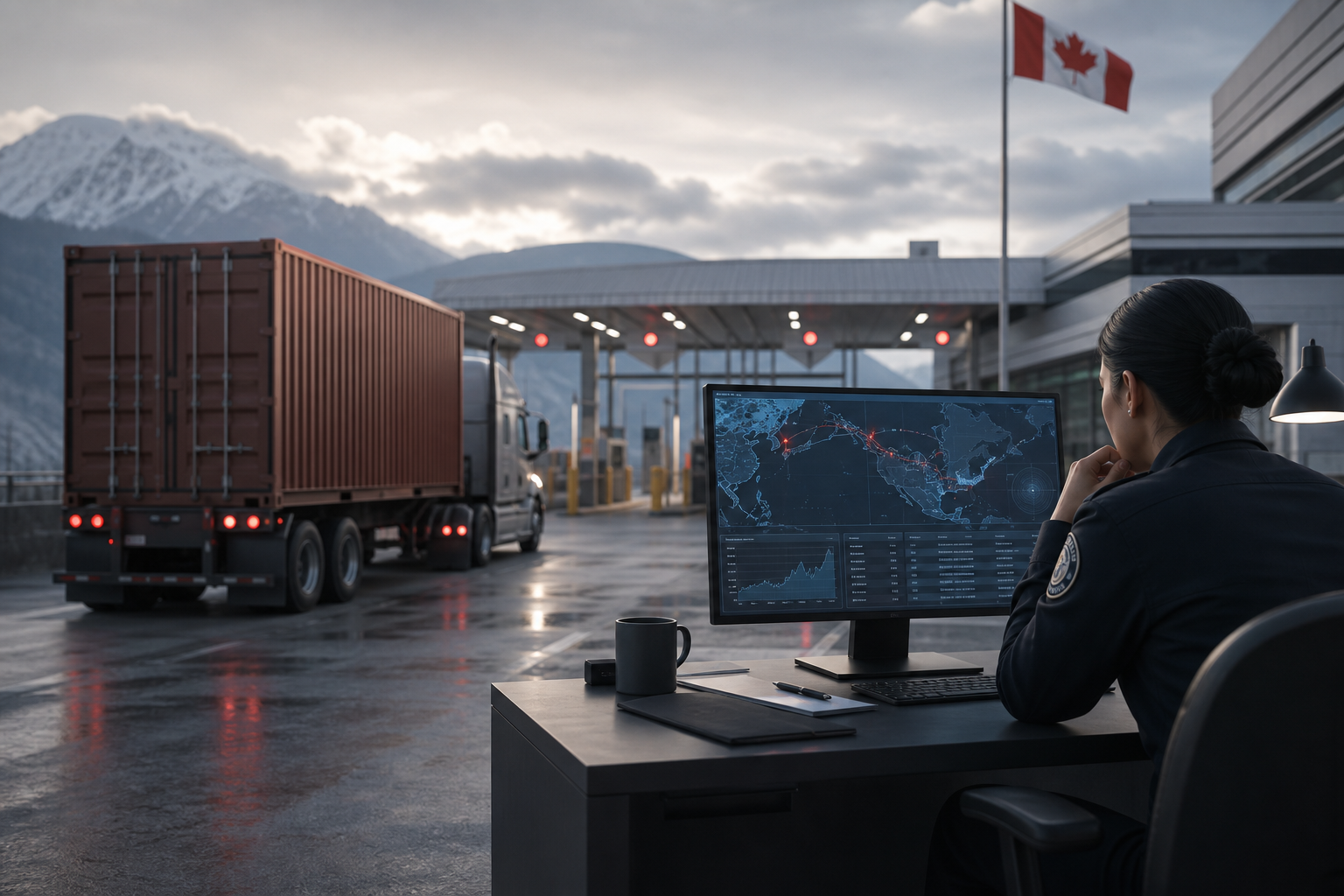

A shipping container that left Shenzhen in March and arrived in Los Angeles via Tijuana in May, carrying lithium-ion battery cells labeled "assembled in Mexico," just triggered an algorithmic flag at U.S. Customs. The weight-to-value ratio is off. The transit time is too short for meaningful assembly. Mexico's semiconductor imports from China spiked 340% in the twelve months prior, while its battery exports to the U.S. rose by nearly the same margin. The algorithm doesn't care about the certificate of origin. It knows what a shell game looks like.
This is the new enforcement reality. The U.S. has moved from reactive tariff audits to proactive, AI-driven screening at the point of entry. The system isn't looking for paperwork errors. It's hunting structural patterns: shipment durations that don't align with claimed assembly work, value-added claims that exceed a country's actual industrial capacity, and trade flows through jurisdictions that became export hubs the moment Section 301 tariffs kicked in.
The Transshipment Target
The focus is a practice called transshipment, goods that originate in China, pass through a third country for minimal processing, and enter the U.S. with a new country-of-origin label to dodge tariffs ranging from 25% to 100%. Vietnam and Mexico are the two loudest signals in the dataset. Both countries have seen Chinese intermediate imports and U.S.-bound exports rise in near-lockstep since 2018, a correlation enforcers are no longer willing to treat as coincidence.
For Canadian exporters, especially those routing goods through the Port of Vancouver or Prince Rupert, this creates immediate friction. Vancouver handles roughly $300 billion in goods annually, much of it bound for the U.S. Midwest. A tightening U.S. border doesn't just mean delayed shipments. It means your logistics chain is now assumed guilty until the data proves otherwise.
The End of Paper Compliance
Traditional certificates of origin were designed for a world where customs officers could physically inspect maybe 2% of inbound containers. The new model is 100% digital inspection, every container, every time. If your documentation shows a product "assembled in Canada" but the algorithm flags that your raw material supplier has a Chinese parent company, or that your shipping route includes a stop in a known transshipment hub, you're getting pulled for secondary review.
This is more than bureaucratic annoyance. It's a rewrite of what compliance means. Speed used to be the logistics KPI. Now it's traceability. A Kelowna-based manufacturer sourcing components from Asia might find itself forced to hand over granular supply chain data, supplier names, shipment weights, individual part origins, just to clear a border the goods used to pass through in hours.
The Broader Risk
The administration's bet is that AI can catch fraud at scale in ways manual audits never could. That's probably true. But high-volume algorithmic screening produces high-volume false positives. Perishable goods sit in inspection. Critical components miss production windows. Legitimate Canadian exporters get flagged because their growth curve happens to match a Chinese shell company's.
There's also a jurisdictional problem. If the U.S. border tightens via AI and flags Canadian goods more aggressively, those "orphaned" shipments don't disappear. They get dumped into the Canadian market, depressing prices in B.C. and forcing a reciprocal enforcement response that Canada isn't currently resourced to execute.
The real shift here isn't technological. The U.S. has decided that decoupling from China isn't enough. It's now policing the entire global supply chain to ensure China isn't embedded in other nations' exports. Your logistics used to be a speed problem. Now it's an evidence problem. And the standard of proof just went algorithmic.
Read Next
How to Eliminate Bridge Financing by Controlling Your Closing Dates
How to position your portfolio for a decade of below-average stock market returns
The Government's 'Productivity Deduction' Is a Rebrand, Not a Reform
Pay Down Your House Before Your Rental: The Tax Math Real Estate Investors Miss