Why Student Tenant Insurance Is the One Expense That Actually Saves You Money
A third-year student at Dalhousie walked into his apartment last November to find four inches of water covering his bedroom floor. The upstairs radiator had cracked. His $2,400 laptop, $900 textbooks, and winter coat were ruined. He had no insurance. He paid to replace it all out of student loans.
Most students see tenant insurance as just another bill. It isn't. The cost is $15 to $30 a month in Canada, less than a Netflix subscription, and the liability protection alone justifies it. Personal property coverage is secondary.
The real value is $1 million of liability
You burn down the kitchen making ramen at 2 a.m. The landlord bills you $80,000 for structural damage and lost rent while repairs happen. Without tenant insurance, that's your debt. With it, the insurer pays.
Standard Canadian tenant policies include $1 million in liability coverage. That protects you if someone is injured in your unit (your roommate's friend trips on your dumbbells and breaks an ankle) or if you accidentally damage the building. Fire, flood from a burst pipe, even a balcony BBQ that gets out of hand, all covered. A lawsuit settlement or judgment in those ranges would follow you for decades. The $240 annual premium starts to look trivial.
Some brokers recommend bumping liability to $2 million. The cost difference is usually $3 to $5 per month. Worth it if you live in a high-rise or share a unit with multiple roommates, where the damage potential is higher.
Off-premises coverage catches people by surprise
Your bike gets stolen from the campus rack. Your backpack disappears from the library. Your luggage is lost on a reading-week flight. Most tenant policies in Canada cover personal property even when it's not in your apartment. That $1,200 road bike locked outside the engineering building is covered, subject to the policy's bicycle sub-limit (often $1,000 to $2,000 unless you buy a rider).
Electronics are the big-ticket replacement. A typical student setup, laptop, phone, tablet, noise-cancelling headphones, external monitor, easily hits $4,000. Replacing all of it out-of-pocket is more than four years of insurance premiums.
Check your parents' policy first
If you're still a dependent, your parents' homeowners policy might extend limited coverage to you while you're living in a dorm or off-campus apartment. "Limited" is the key word. Most extensions cap coverage at $5,000 to $10,000, and liability protection may not apply. Call their insurer and ask for the specific limits and exclusions. If the coverage is insufficient, you'll need your own policy.
Landlords are requiring it now
Vacancy rates in Toronto, Vancouver, and Halifax are under 2 percent. Landlords are choosy. Many now make tenant insurance a mandatory lease clause. Show up without proof of insurance and you may lose the unit to the next applicant who has it. Even if it's not required, having a policy signals that you're a lower-risk tenant. That can matter when twenty people are competing for the same two-bedroom.
The deductible is where cost lives
Most policies carry a $500 to $1,000 deductible. If your claim is below that threshold, you pay it yourself. A $700 broken window means you're out $700 even with coverage. The insurance is for catastrophic loss (everything destroyed in a fire, a $50,000 liability judgment), not minor repairs. Know your deductible before you buy, and don't file small claims, it can raise your premium later.
One fire, one flood, one lawsuit. That's the scenario the $20 monthly policy is built for. Everything else is just bonus coverage.


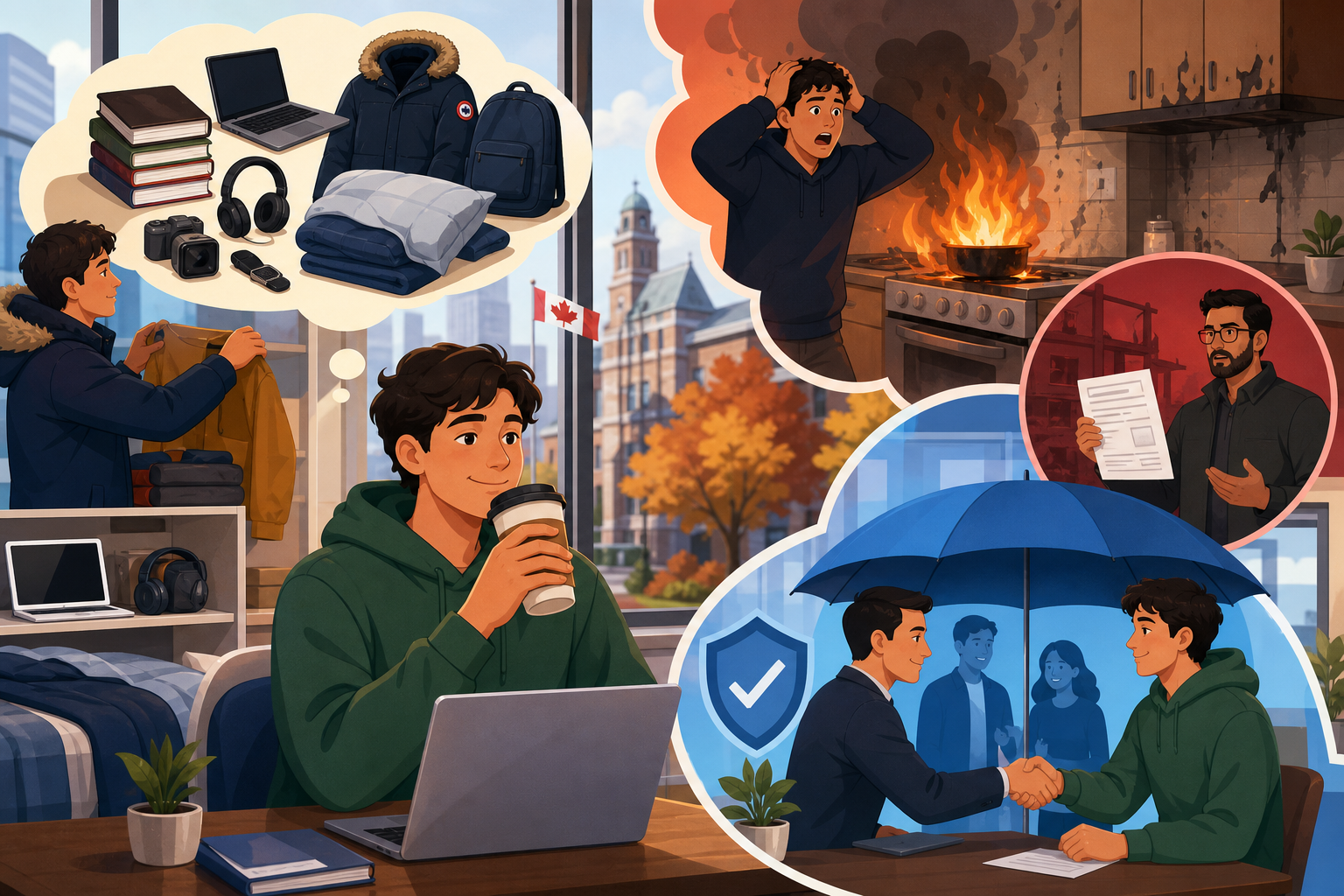

A third-year student at Dalhousie walked into his apartment last November to find four inches of water covering his bedroom floor. The upstairs radiator had cracked. His $2,400 laptop, $900 textbooks, and winter coat were ruined. He had no insurance. He paid to replace it all out of student loans.
Most students see tenant insurance as just another bill. It isn't. The cost is $15 to $30 a month in Canada, less than a Netflix subscription, and the liability protection alone justifies it. Personal property coverage is secondary.
The real value is $1 million of liability
You burn down the kitchen making ramen at 2 a.m. The landlord bills you $80,000 for structural damage and lost rent while repairs happen. Without tenant insurance, that's your debt. With it, the insurer pays.
Standard Canadian tenant policies include $1 million in liability coverage. That protects you if someone is injured in your unit (your roommate's friend trips on your dumbbells and breaks an ankle) or if you accidentally damage the building. Fire, flood from a burst pipe, even a balcony BBQ that gets out of hand, all covered. A lawsuit settlement or judgment in those ranges would follow you for decades. The $240 annual premium starts to look trivial.
Some brokers recommend bumping liability to $2 million. The cost difference is usually $3 to $5 per month. Worth it if you live in a high-rise or share a unit with multiple roommates, where the damage potential is higher.
Off-premises coverage catches people by surprise
Your bike gets stolen from the campus rack. Your backpack disappears from the library. Your luggage is lost on a reading-week flight. Most tenant policies in Canada cover personal property even when it's not in your apartment. That $1,200 road bike locked outside the engineering building is covered, subject to the policy's bicycle sub-limit (often $1,000 to $2,000 unless you buy a rider).
Electronics are the big-ticket replacement. A typical student setup, laptop, phone, tablet, noise-cancelling headphones, external monitor, easily hits $4,000. Replacing all of it out-of-pocket is more than four years of insurance premiums.
Check your parents' policy first
If you're still a dependent, your parents' homeowners policy might extend limited coverage to you while you're living in a dorm or off-campus apartment. "Limited" is the key word. Most extensions cap coverage at $5,000 to $10,000, and liability protection may not apply. Call their insurer and ask for the specific limits and exclusions. If the coverage is insufficient, you'll need your own policy.
Landlords are requiring it now
Vacancy rates in Toronto, Vancouver, and Halifax are under 2 percent. Landlords are choosy. Many now make tenant insurance a mandatory lease clause. Show up without proof of insurance and you may lose the unit to the next applicant who has it. Even if it's not required, having a policy signals that you're a lower-risk tenant. That can matter when twenty people are competing for the same two-bedroom.
The deductible is where cost lives
Most policies carry a $500 to $1,000 deductible. If your claim is below that threshold, you pay it yourself. A $700 broken window means you're out $700 even with coverage. The insurance is for catastrophic loss (everything destroyed in a fire, a $50,000 liability judgment), not minor repairs. Know your deductible before you buy, and don't file small claims, it can raise your premium later.
One fire, one flood, one lawsuit. That's the scenario the $20 monthly policy is built for. Everything else is just bonus coverage.
Read Next
How to Eliminate Bridge Financing by Controlling Your Closing Dates
How to position your portfolio for a decade of below-average stock market returns
The Government's 'Productivity Deduction' Is a Rebrand, Not a Reform
Pay Down Your House Before Your Rental: The Tax Math Real Estate Investors Miss