Trump's Tariffs Are Splitting Iowa Voters on Whether Canada Deserves Friend or Foe Treatment
A farmer in a John Deere cap leaning against the corn dog stand at the Iowa State Fair this week told CBC News he thought Canada was "probably ripping us off, too." Fifty yards away, a seed supplier said the tariffs on Canadian steel had jacked up the price of his grain bins by 18%. Same fair. Same political moment. Opposite conclusions about whether America's northern neighbor is a partner or a parasite.
The Iowa State Fair has always been retail politics at maximum density, candidates work rope lines, kiss babies, flip pork chops on a grill while cameras roll. But in August 2026, with the midterms less than three months away and Trump's tariff agenda still reshaping cross-border commerce, the fair has become a miniature referendum on something more specific: whether Canada deserves the friend treatment or the adversary treatment. And Iowa voters, it turns out, cannot agree.
The economic feedback loop runs both ways
The split isn't random. It tracks to whose paycheck depends on what. Iowans whose margins rely on cheap Canadian inputs, fertilizer, fuel, fabricated steel, see the tariffs as a self-inflicted wound. Iowans in sectors that compete with Canadian imports see them as long-overdue protection. Both groups are farming the same soil, often living in the same county, and the guy at the fair selling them a lemonade has no idea which camp they're in until the conversation turns to Ottawa.
This matters beyond Iowa because Iowa is a bellwether state where economic sentiment often predicts national outcomes. And the confusion here is structural, not partisan. Republican primary candidates working the fairgrounds this month have had to navigate a voter base that simultaneously wants toughness on trade and relief from rising input costs. Those two demands point in opposite directions when the tariff target is Canada, a country that supplies both the things Iowans sell (export markets for corn, soybeans, pork) and the things they buy (steel for equipment, potash for fertilizer, energy to keep costs down).
The USMCA, the trade deal that replaced NAFTA in 2020, is up for its six-year joint review in 2026, which gives every candidate at the fair a ready-made talking point about renegotiating terms. But renegotiation rhetoric plays differently depending on who's listening. To a hog farmer who watched Canadian retaliatory tariffs crush his pork exports in 2025, "getting tough" sounds like the problem, not the solution. To a guy who owns a small foundry and thinks subsidized Canadian aluminum undercuts his bids, it sounds like the only move that makes sense.
Friend-shoring runs into the friend
The deeper contradiction is strategic. Washington spent the last three years talking about "friend-shoring", moving supply chains out of China and into allied democracies. Canada is the closest allied democracy America has, geographically and institutionally. NORAD. Five Eyes. Integrated energy grids. The whole framework. And yet Section 232 tariffs, the ones justified on national security grounds, are still hitting Canadian steel and aluminum as if Edmonton were Shenzhen.
Voters at the fair who work in manufacturing often bring this up unprompted. They understand the China problem. What they don't understand is why the tool designed to counter Beijing is being used on a country that shares a defense perimeter with them. A welder in Davenport who spoke to CBC said it felt like "putting a lock on your buddy's toolshed because you don't trust the guy down the street."
The currency effect muddles it further. When the Canadian Dollar weakened against the U.S. Dollar in early 2026, it partially offset the tariff hit for some Canadian exporters, making their goods cheaper even after the duty. That helped a few Iowan buyers but enraged the domestic producers who thought the tariffs were supposed to level the field. The whole system started feeling rigged in both directions depending on the week.
What's landing in Iowa is not a neat left-right divide on trade. It's a cross-sectoral patchwork where the same voter can hold two conflicting views, Canada as reliable partner, Canada as convenient scapegoat, and reach for whichever one fits the conversation. The fair is just where that contradiction becomes visible under the Ferris wheel lights.


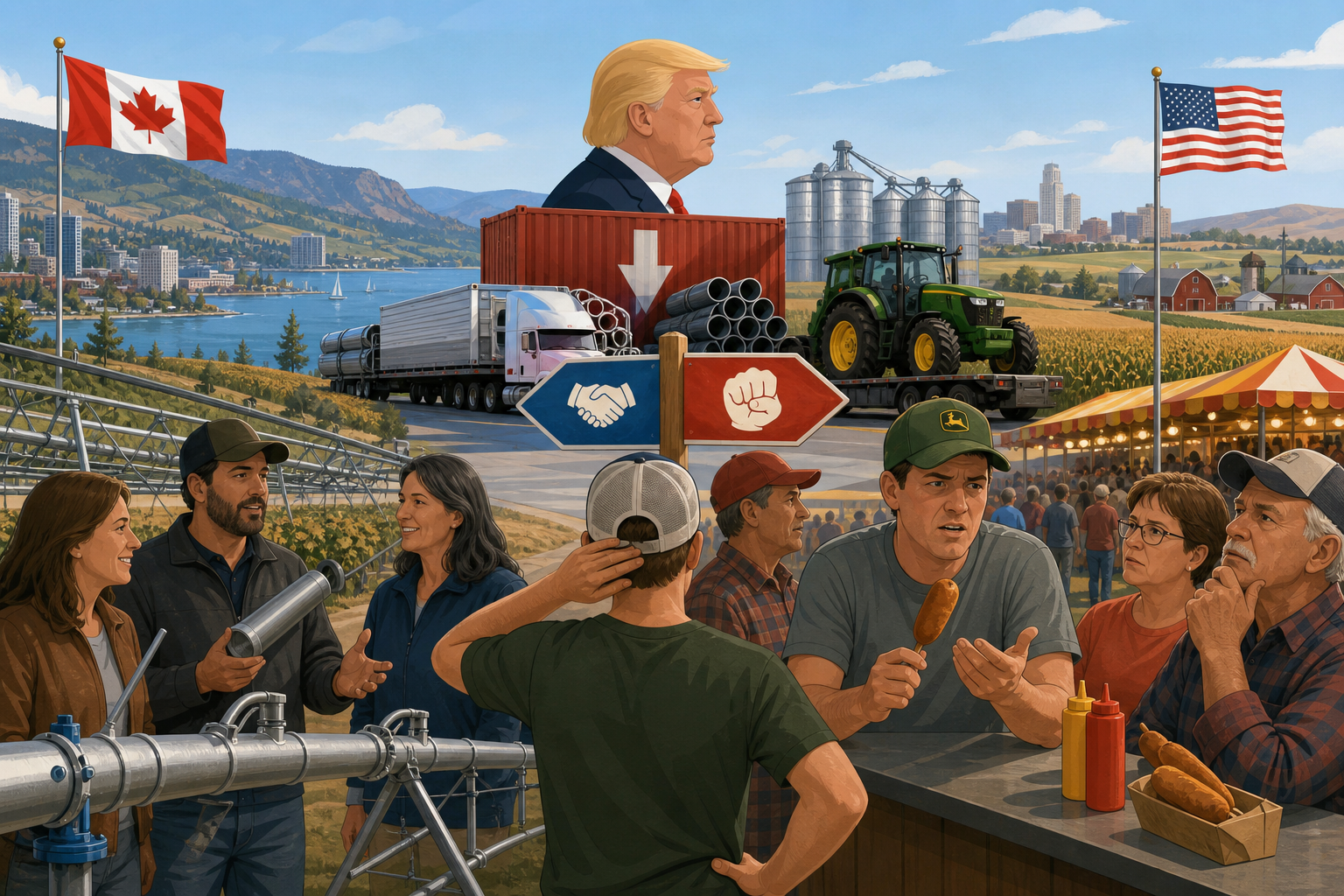

A farmer in a John Deere cap leaning against the corn dog stand at the Iowa State Fair this week told CBC News he thought Canada was "probably ripping us off, too." Fifty yards away, a seed supplier said the tariffs on Canadian steel had jacked up the price of his grain bins by 18%. Same fair. Same political moment. Opposite conclusions about whether America's northern neighbor is a partner or a parasite.
The Iowa State Fair has always been retail politics at maximum density, candidates work rope lines, kiss babies, flip pork chops on a grill while cameras roll. But in August 2026, with the midterms less than three months away and Trump's tariff agenda still reshaping cross-border commerce, the fair has become a miniature referendum on something more specific: whether Canada deserves the friend treatment or the adversary treatment. And Iowa voters, it turns out, cannot agree.
The economic feedback loop runs both ways
The split isn't random. It tracks to whose paycheck depends on what. Iowans whose margins rely on cheap Canadian inputs, fertilizer, fuel, fabricated steel, see the tariffs as a self-inflicted wound. Iowans in sectors that compete with Canadian imports see them as long-overdue protection. Both groups are farming the same soil, often living in the same county, and the guy at the fair selling them a lemonade has no idea which camp they're in until the conversation turns to Ottawa.
This matters beyond Iowa because Iowa is a bellwether state where economic sentiment often predicts national outcomes. And the confusion here is structural, not partisan. Republican primary candidates working the fairgrounds this month have had to navigate a voter base that simultaneously wants toughness on trade and relief from rising input costs. Those two demands point in opposite directions when the tariff target is Canada, a country that supplies both the things Iowans sell (export markets for corn, soybeans, pork) and the things they buy (steel for equipment, potash for fertilizer, energy to keep costs down).
The USMCA, the trade deal that replaced NAFTA in 2020, is up for its six-year joint review in 2026, which gives every candidate at the fair a ready-made talking point about renegotiating terms. But renegotiation rhetoric plays differently depending on who's listening. To a hog farmer who watched Canadian retaliatory tariffs crush his pork exports in 2025, "getting tough" sounds like the problem, not the solution. To a guy who owns a small foundry and thinks subsidized Canadian aluminum undercuts his bids, it sounds like the only move that makes sense.
Friend-shoring runs into the friend
The deeper contradiction is strategic. Washington spent the last three years talking about "friend-shoring", moving supply chains out of China and into allied democracies. Canada is the closest allied democracy America has, geographically and institutionally. NORAD. Five Eyes. Integrated energy grids. The whole framework. And yet Section 232 tariffs, the ones justified on national security grounds, are still hitting Canadian steel and aluminum as if Edmonton were Shenzhen.
Voters at the fair who work in manufacturing often bring this up unprompted. They understand the China problem. What they don't understand is why the tool designed to counter Beijing is being used on a country that shares a defense perimeter with them. A welder in Davenport who spoke to CBC said it felt like "putting a lock on your buddy's toolshed because you don't trust the guy down the street."
The currency effect muddles it further. When the Canadian Dollar weakened against the U.S. Dollar in early 2026, it partially offset the tariff hit for some Canadian exporters, making their goods cheaper even after the duty. That helped a few Iowan buyers but enraged the domestic producers who thought the tariffs were supposed to level the field. The whole system started feeling rigged in both directions depending on the week.
What's landing in Iowa is not a neat left-right divide on trade. It's a cross-sectoral patchwork where the same voter can hold two conflicting views, Canada as reliable partner, Canada as convenient scapegoat, and reach for whichever one fits the conversation. The fair is just where that contradiction becomes visible under the Ferris wheel lights.
Sources
Read Next
How to Eliminate Bridge Financing by Controlling Your Closing Dates
How to position your portfolio for a decade of below-average stock market returns
The Government's 'Productivity Deduction' Is a Rebrand, Not a Reform
Pay Down Your House Before Your Rental: The Tax Math Real Estate Investors Miss