Toronto Townhouse Developer Enters Creditor Protection With 65 Unsold Units
A 147-unit townhouse development at 1648 Victoria Park Avenue in North York completed construction with 65 units still sitting empty. That number, 44% of the project, tells you everything about the financing gap that put Solotex Group into court-ordered receivership in late 2024. The issue wasn't that nobody wanted to live near the Eglinton Crosstown corridor. The issue was that the people who signed contracts in 2021 couldn't qualify for mortgages in 2024.
The Vic Towns is a stacked townhouse project, the kind of missing-middle housing that gets praised in policy white papers for adding density without high-rise towers. Solotex Group broke ground when rates were still under 2%. Pre-construction buyers locked in prices that assumed a world where stress-test rates hovered around 5%. By the time units were ready for occupancy, the Bank of Canada overnight rate sat between 4.75% and 5.00%, and the stress test had pushed qualifying hurdles well into the 7% range. A buyer who could carry a $650,000 mortgage in 2021 could now qualify for maybe $490,000. The appraisal gap became a chasm.
When the close fails, the developer holds the bag
In pre-construction, the developer's risk profile flips the day a building gets its occupancy permit. Before that moment, unsold units are an abstraction, a problem for later. After that moment, they are high-interest liabilities accruing carrying costs every single day. Property taxes, condo fees, insurance, debt servicing on construction loans that were supposed to be repaid by buyer closings, all of it piles up fast.
For Solotex, the math broke somewhere in the fall of 2024. Sixty-five units didn't close. The buyers either couldn't secure financing or walked away from their deposits because the appraisal came in $80,000 or $100,000 under contract. The developer's lenders, facing months of non-performance on a loan that was supposed to convert to takeout financing, moved to receivership under the Bankruptcy and Insolvency Act. KSV Restructuring, a frequent appointee in these cases, took over the file with a mandate to liquidate the remaining inventory and recover what it could for secured creditors.
Toronto development charges had jumped roughly 20% in mid-2024, squeezing margins on projects that were already running tight. The Victoria Park corridor had been sold to investors as a future transit-premium zone, anchored by the Eglinton LRT. But infrastructure delays meant the premium never materialized. Buyers who thought they were locking in 2026 values at 2021 prices found themselves holding contracts for units that appraised closer to what comparable resale townhomes were trading for, sometimes less, given the lack of walk-in equity.
Stacked townhouses live in the affordability gap
The specific housing type matters here. Stacked townhomes sit in an awkward price band. Too expensive for most first-time buyers stretching for anything under $600,000. Not prestigious enough, and with no land value, to compete with traditional freehold product. In a rising market, that gap gets papered over by appreciation. In a flat or softening market, it becomes a trap. The Vic Towns units that Solotex couldn't move weren't bad product. They were completed, physically sound, and located in a node that will eventually intensify. They just hit the market at a moment when the financing environment made them unaffordable to the cohort they were designed for.
Receivership sales often present a de-risked opportunity for end-users willing to move quickly. The court-appointed receiver prioritizes speed over maximum recovery, which can translate to realistic pricing. Units that were listed at $720,000 in 2023 are now being cleared at $630,000 or less, close enough to current appraisals that a buyer with 20% down can close without drama.
Solotex is not the first developer to carry inventory into insolvency this cycle, and the trend is upward. The failure here wasn't operational. It was structural: a financing model built for one interest-rate regime colliding with a completely different one 36 months later.


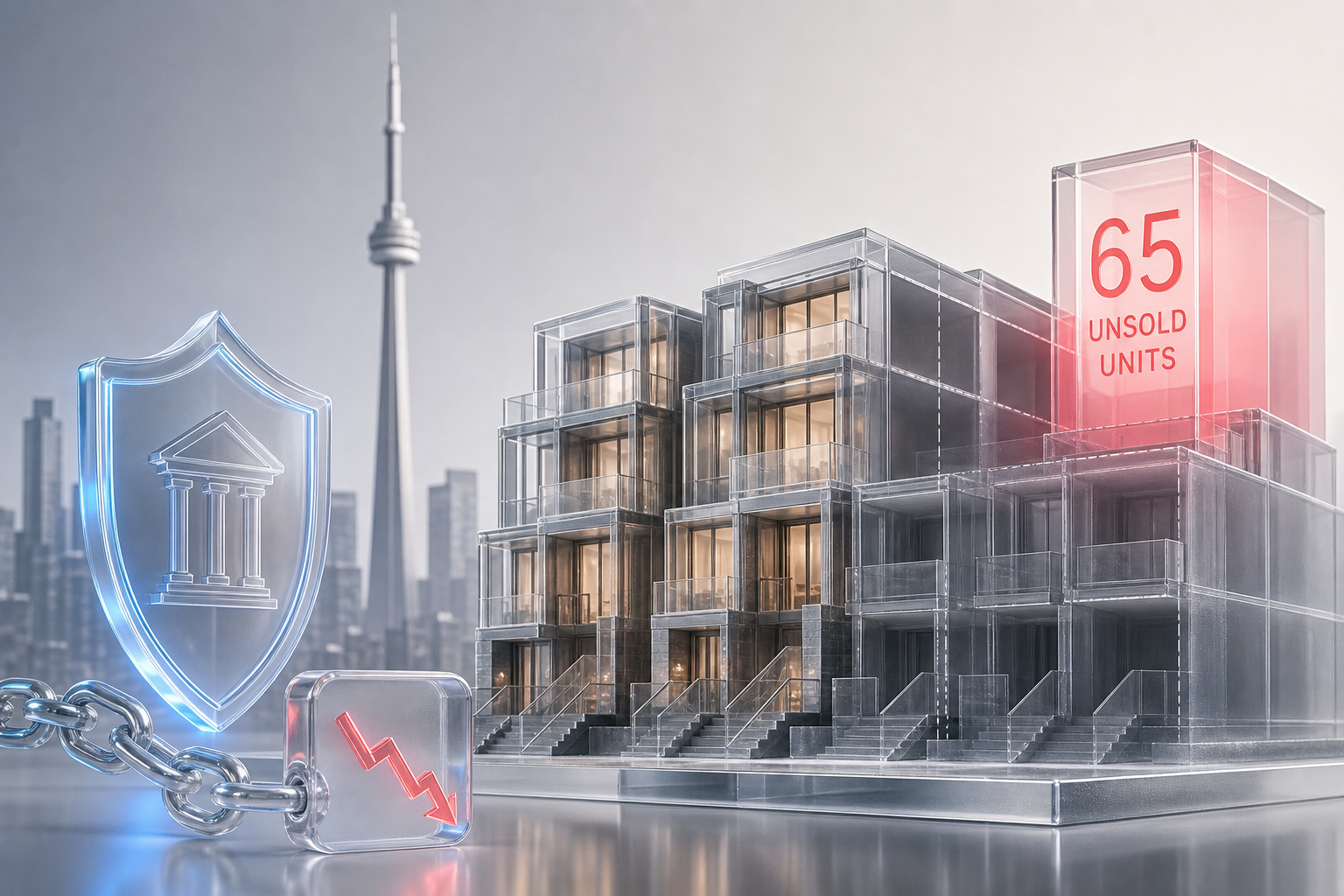

A 147-unit townhouse development at 1648 Victoria Park Avenue in North York completed construction with 65 units still sitting empty. That number, 44% of the project, tells you everything about the financing gap that put Solotex Group into court-ordered receivership in late 2024. The issue wasn't that nobody wanted to live near the Eglinton Crosstown corridor. The issue was that the people who signed contracts in 2021 couldn't qualify for mortgages in 2024.
The Vic Towns is a stacked townhouse project, the kind of missing-middle housing that gets praised in policy white papers for adding density without high-rise towers. Solotex Group broke ground when rates were still under 2%. Pre-construction buyers locked in prices that assumed a world where stress-test rates hovered around 5%. By the time units were ready for occupancy, the Bank of Canada overnight rate sat between 4.75% and 5.00%, and the stress test had pushed qualifying hurdles well into the 7% range. A buyer who could carry a $650,000 mortgage in 2021 could now qualify for maybe $490,000. The appraisal gap became a chasm.
When the close fails, the developer holds the bag
In pre-construction, the developer's risk profile flips the day a building gets its occupancy permit. Before that moment, unsold units are an abstraction, a problem for later. After that moment, they are high-interest liabilities accruing carrying costs every single day. Property taxes, condo fees, insurance, debt servicing on construction loans that were supposed to be repaid by buyer closings, all of it piles up fast.
For Solotex, the math broke somewhere in the fall of 2024. Sixty-five units didn't close. The buyers either couldn't secure financing or walked away from their deposits because the appraisal came in $80,000 or $100,000 under contract. The developer's lenders, facing months of non-performance on a loan that was supposed to convert to takeout financing, moved to receivership under the Bankruptcy and Insolvency Act. KSV Restructuring, a frequent appointee in these cases, took over the file with a mandate to liquidate the remaining inventory and recover what it could for secured creditors.
Toronto development charges had jumped roughly 20% in mid-2024, squeezing margins on projects that were already running tight. The Victoria Park corridor had been sold to investors as a future transit-premium zone, anchored by the Eglinton LRT. But infrastructure delays meant the premium never materialized. Buyers who thought they were locking in 2026 values at 2021 prices found themselves holding contracts for units that appraised closer to what comparable resale townhomes were trading for, sometimes less, given the lack of walk-in equity.
Stacked townhouses live in the affordability gap
The specific housing type matters here. Stacked townhomes sit in an awkward price band. Too expensive for most first-time buyers stretching for anything under $600,000. Not prestigious enough, and with no land value, to compete with traditional freehold product. In a rising market, that gap gets papered over by appreciation. In a flat or softening market, it becomes a trap. The Vic Towns units that Solotex couldn't move weren't bad product. They were completed, physically sound, and located in a node that will eventually intensify. They just hit the market at a moment when the financing environment made them unaffordable to the cohort they were designed for.
Receivership sales often present a de-risked opportunity for end-users willing to move quickly. The court-appointed receiver prioritizes speed over maximum recovery, which can translate to realistic pricing. Units that were listed at $720,000 in 2023 are now being cleared at $630,000 or less, close enough to current appraisals that a buyer with 20% down can close without drama.
Solotex is not the first developer to carry inventory into insolvency this cycle, and the trend is upward. The failure here wasn't operational. It was structural: a financing model built for one interest-rate regime colliding with a completely different one 36 months later.
Read Next
How to Eliminate Bridge Financing by Controlling Your Closing Dates
How to position your portfolio for a decade of below-average stock market returns
The Government's 'Productivity Deduction' Is a Rebrand, Not a Reform
Pay Down Your House Before Your Rental: The Tax Math Real Estate Investors Miss