The US alcohol industry's tariff fears aren't overblown, they're just late
Canada stopped being a friendly customer sometime around 2018, but the spreadsheets at most American distilleries didn't catch up until this month.
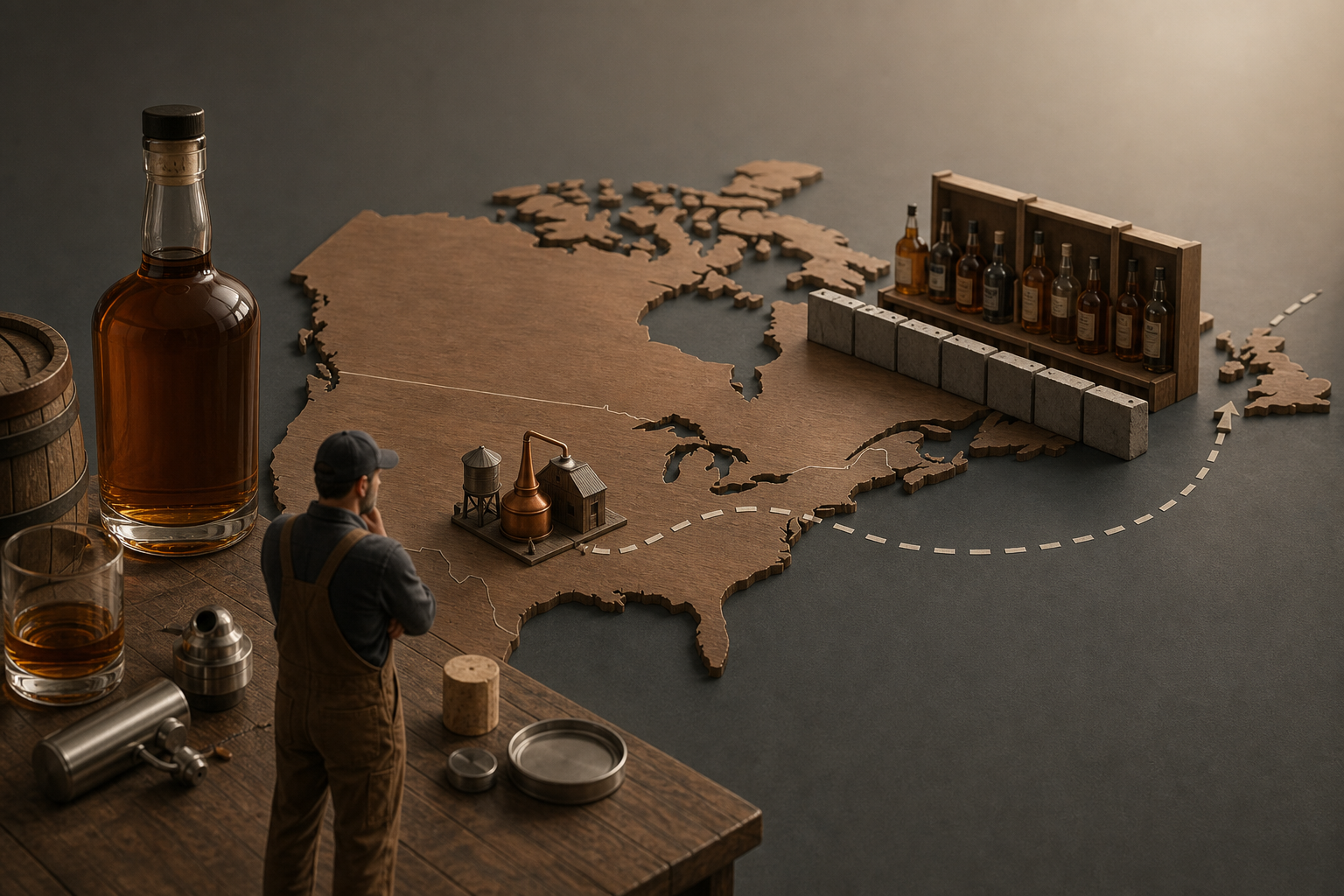
The Distilled Spirits Council pegged Canada as a $500-million-per-year market for U.S. spirits in 2024. That figure hides the structural problem: for craft producers in Kentucky or Tennessee, Canada isn't just the largest export market, it's the only one that pencils. Trans-Atlantic freight kills margin. Mexico has taste for tequila, not bourbon. Canada is close, affluent, has historical appetite for American whiskey, and until last year, was tariff-free under USMCA. The entire growth model for a 50-employee distillery depended on that map staying intact.
The tariff machinery moved faster than the industry. When Trump floated universal baseline tariffs of 10% to 25% on all imports in late 2025, Canadian officials didn't wait to see if spirits would be carved out. They started building retaliation lists. Bourbon appeared on those lists in late January 2026, and the whiskey producers who thought they'd dodged the 2018 trade war found themselves right back in it, except this time with half their export infrastructure already committed.
Why the lag matters
The 2018-2021 period hit American whiskey exports to the EU and Canada hard. Retaliatory tariffs of 25% drove double-digit percentage drops in shipments. After those tariffs lifted, the industry spent 2022 through 2024 rebuilding relationships with Canadian provincial liquor boards, locking in shelf space, raising production forecasts. Small and mid-sized distillers borrowed against those forecasts. By mid-2025, most had signed multi-year contracts with LCBO in Ontario or SAQ in Quebec, agreements that included fixed pricing and volume commitments.
Then the map changed again. Canada's liquor boards don't need federal tariffs to make life difficult for U.S. brands. They can simply stop renewing contracts, a quiet form of retaliation that doesn't require public announcements or WTO filings. A U.S. producer learns their bourbon is off the shelf when the order doesn't come through. No appeal process. No hearing. The board moves to a Scottish single malt instead.
That's the mechanism American producers actually fear: not the 25% tariff headline, but the shadow delisting that happens when provincial monopolies decide U.S. whiskey is too politically expensive to carry. The tariff raises the price. The delisting erases the revenue line entirely.
The Kentucky factor
Retaliatory tariffs are surgically aimed. Canada's 2018 list targeted bourbon specifically because Kentucky is Mitch McConnell's state and Tennessee is crucial swing territory. The calculation is transparent: make the pain visible to the politicians who have leverage in Washington. Bourbon doesn't get hit because Canada dislikes whiskey. It gets hit because Canada understands the U.S. Senate.
For conglomerates like Diageo or Pernod Ricard, a tariff war is a margin problem. They have European, Asian, and Latin American portfolios to offset a Canadian freeze. For a craft distiller in Bardstown shipping 60% of their export volume to Ontario, it's existential. The domestic U.S. market is large, but shelf space in Total Wine is already spoken for. Distribution is controlled by wholesalers with little interest in a 300-case producer. Going back to farmers markets isn't a business plan.
The worst part is the cost structure. A trade war drives up input prices even for bottles that never leave the U.S. Specialized glass, imported corks, stainless steel tanks, those components cross borders before the whiskey does. Tariffs on Canadian steel or aluminum trigger price hikes from suppliers in Ohio and Pennsylvania. The distiller's cost base rises whether they export or not.
The industry isn't catastrophizing. It's just finally pricing in a risk it should have modeled in 2018 and didn't. The hangover was always coming. The surprise is that anyone thought last call wouldn't arrive.



Canada stopped being a friendly customer sometime around 2018, but the spreadsheets at most American distilleries didn't catch up until this month.
The Distilled Spirits Council pegged Canada as a $500-million-per-year market for U.S. spirits in 2024. That figure hides the structural problem: for craft producers in Kentucky or Tennessee, Canada isn't just the largest export market, it's the only one that pencils. Trans-Atlantic freight kills margin. Mexico has taste for tequila, not bourbon. Canada is close, affluent, has historical appetite for American whiskey, and until last year, was tariff-free under USMCA. The entire growth model for a 50-employee distillery depended on that map staying intact.
The tariff machinery moved faster than the industry. When Trump floated universal baseline tariffs of 10% to 25% on all imports in late 2025, Canadian officials didn't wait to see if spirits would be carved out. They started building retaliation lists. Bourbon appeared on those lists in late January 2026, and the whiskey producers who thought they'd dodged the 2018 trade war found themselves right back in it, except this time with half their export infrastructure already committed.
Why the lag matters
The 2018-2021 period hit American whiskey exports to the EU and Canada hard. Retaliatory tariffs of 25% drove double-digit percentage drops in shipments. After those tariffs lifted, the industry spent 2022 through 2024 rebuilding relationships with Canadian provincial liquor boards, locking in shelf space, raising production forecasts. Small and mid-sized distillers borrowed against those forecasts. By mid-2025, most had signed multi-year contracts with LCBO in Ontario or SAQ in Quebec, agreements that included fixed pricing and volume commitments.
Then the map changed again. Canada's liquor boards don't need federal tariffs to make life difficult for U.S. brands. They can simply stop renewing contracts, a quiet form of retaliation that doesn't require public announcements or WTO filings. A U.S. producer learns their bourbon is off the shelf when the order doesn't come through. No appeal process. No hearing. The board moves to a Scottish single malt instead.
That's the mechanism American producers actually fear: not the 25% tariff headline, but the shadow delisting that happens when provincial monopolies decide U.S. whiskey is too politically expensive to carry. The tariff raises the price. The delisting erases the revenue line entirely.
The Kentucky factor
Retaliatory tariffs are surgically aimed. Canada's 2018 list targeted bourbon specifically because Kentucky is Mitch McConnell's state and Tennessee is crucial swing territory. The calculation is transparent: make the pain visible to the politicians who have leverage in Washington. Bourbon doesn't get hit because Canada dislikes whiskey. It gets hit because Canada understands the U.S. Senate.
For conglomerates like Diageo or Pernod Ricard, a tariff war is a margin problem. They have European, Asian, and Latin American portfolios to offset a Canadian freeze. For a craft distiller in Bardstown shipping 60% of their export volume to Ontario, it's existential. The domestic U.S. market is large, but shelf space in Total Wine is already spoken for. Distribution is controlled by wholesalers with little interest in a 300-case producer. Going back to farmers markets isn't a business plan.
The worst part is the cost structure. A trade war drives up input prices even for bottles that never leave the U.S. Specialized glass, imported corks, stainless steel tanks, those components cross borders before the whiskey does. Tariffs on Canadian steel or aluminum trigger price hikes from suppliers in Ohio and Pennsylvania. The distiller's cost base rises whether they export or not.
The industry isn't catastrophizing. It's just finally pricing in a risk it should have modeled in 2018 and didn't. The hangover was always coming. The surprise is that anyone thought last call wouldn't arrive.
Read Next
How to Eliminate Bridge Financing by Controlling Your Closing Dates
How to position your portfolio for a decade of below-average stock market returns
The Government's 'Productivity Deduction' Is a Rebrand, Not a Reform
Pay Down Your House Before Your Rental: The Tax Math Real Estate Investors Miss