Kelowna Tops Canada's 2026 Wildfire Risk Rankings: What Condo Buyers Need to Know
Natural Resources Canada's 2026 forecasting model now assigns Kelowna the country's highest wildfire risk score, a designation that carries more weight than seasonal warnings used to. The ranking is not based on historical averages. It reflects next-generation climate modeling that integrates temperature trends, fuel loads in the wildland-urban interface, and the valley's unique topography into a forward-looking assessment of where fire is most likely to intersect with residential development.
For condo buyers, this matters in ways that go beyond evacuation drills. The risk score directly affects insurance availability, construction costs, and the long-term value of properties that meet, or fail to meet, new fire-resistance standards.
Why Kelowna Ranks First
The Okanagan Valley sits in a deep canyon that creates what fire specialists call a chimney effect. When wind patterns shift, flames accelerate up canyon walls toward residential plateaus where development has pushed into forested hillsides. Summer temperatures routinely exceed 35°C for weeks, desiccating fuel sources across the interface zones where homes meet forest. The 2023 McDougall Creek fire, which forced the evacuation of over 10,000 residents, remains the primary data point in current risk modeling, not because it was an outlier, but because it demonstrated the pattern that forecasting now expects to repeat.
The ranking is not a probability of total loss. Kelowna hosts one of North America's most experienced wildfire response infrastructures. But high risk changes the economics of development and ownership even when suppression succeeds.
The Insurance Problem
Strata corporations across the Okanagan have seen insurance deductibles rise and premiums increase between 15% and 40% in high-risk years. The #1 ranking tightens that pressure. Some new condo developments now struggle to secure affordable coverage at all, creating what industry observers describe as emerging insurance deserts where underwriting simply withdraws from certain interface zones. The result is not that buildings burn, it is that they become harder to finance, harder to insure, and harder to sell.
Buyers should request current strata insurance documents and ask whether the reserve fund has been adjusted to cover rising deductibles. A building's strata fees are increasingly a risk indicator: sharp increases often reflect the board's response to insurance market conditions that have not yet stabilized.
Construction and Certification
Recent BC Building Code updates emphasize fire-rated materials for exteriors in high-risk zones, raising construction costs for new inventory. But those costs translate into durability. Modern concrete-and-glass towers are inherently more fire-resistant than the wood-frame suburban sprawl that characterized older Kelowna development. The paradox is that density, often perceived as riskier, offers structural protection that detached homes in the interface do not.
FireSmart BC compliance is no longer cosmetic. Properties with certification, meaning assessed landscape design, building materials, and defensible space, are becoming a distinct asset class. Resale value increasingly hinges on whether the building and its surroundings meet standards that lower insurance exposure and improve evacuation logistics.
The HVAC Factor
A condo's air filtration system is now a critical resale feature. Seasonal smoke from regional fires, even when the building itself is safe, degrades air quality enough to drive health-related real estate decisions. MERV 13+ filtration and HEPA integration are no longer luxury upgrades. They are the baseline expectation for buildings marketed as climate-resilient.
Buyers should confirm whether the building's HVAC was designed or retrofitted to handle smoke events that can last weeks. The system's capacity matters as much as the building's fire rating when smoke becomes the recurring threat rather than flame.
What the Market Actually Shows
Despite high-profile fires in 2003, 2017, and 2023, Kelowna real estate has rebounded quickly. Buyer demand continues to outpace perceived climate risk, especially for properties that demonstrate fire-hardened design and upgraded systems. The ranking does not signal collapse. It signals segmentation: buildings that meet the new standard will hold value, and those that do not will face friction in financing and resale.
The #1 risk designation is not a forecast of disaster. It is a recalibration of what prudent ownership looks like in a valley where fire is now a structural feature of the landscape, not a seasonal anomaly.


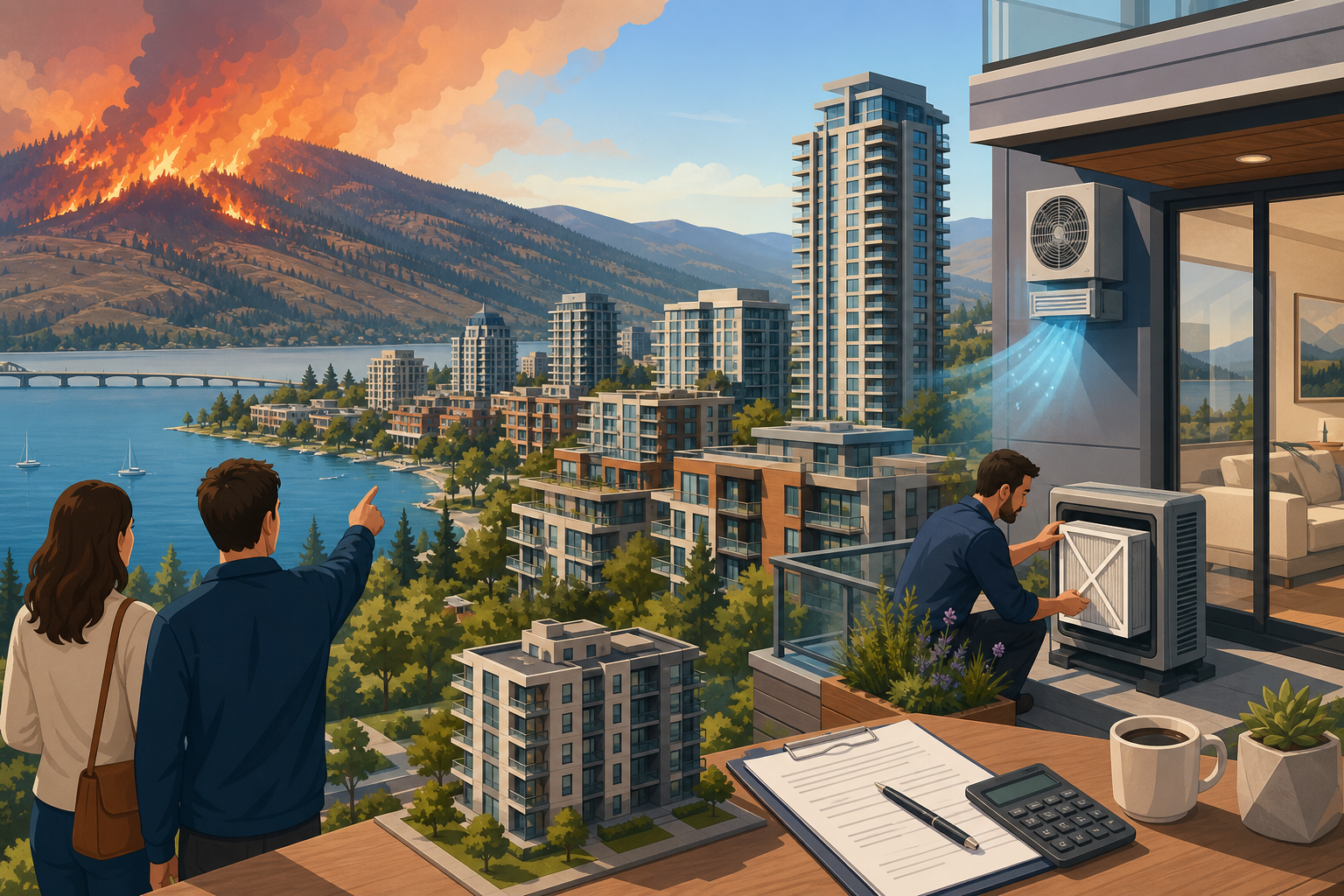

Natural Resources Canada's 2026 forecasting model now assigns Kelowna the country's highest wildfire risk score, a designation that carries more weight than seasonal warnings used to. The ranking is not based on historical averages. It reflects next-generation climate modeling that integrates temperature trends, fuel loads in the wildland-urban interface, and the valley's unique topography into a forward-looking assessment of where fire is most likely to intersect with residential development.
For condo buyers, this matters in ways that go beyond evacuation drills. The risk score directly affects insurance availability, construction costs, and the long-term value of properties that meet, or fail to meet, new fire-resistance standards.
Why Kelowna Ranks First
The Okanagan Valley sits in a deep canyon that creates what fire specialists call a chimney effect. When wind patterns shift, flames accelerate up canyon walls toward residential plateaus where development has pushed into forested hillsides. Summer temperatures routinely exceed 35°C for weeks, desiccating fuel sources across the interface zones where homes meet forest. The 2023 McDougall Creek fire, which forced the evacuation of over 10,000 residents, remains the primary data point in current risk modeling, not because it was an outlier, but because it demonstrated the pattern that forecasting now expects to repeat.
The ranking is not a probability of total loss. Kelowna hosts one of North America's most experienced wildfire response infrastructures. But high risk changes the economics of development and ownership even when suppression succeeds.
The Insurance Problem
Strata corporations across the Okanagan have seen insurance deductibles rise and premiums increase between 15% and 40% in high-risk years. The #1 ranking tightens that pressure. Some new condo developments now struggle to secure affordable coverage at all, creating what industry observers describe as emerging insurance deserts where underwriting simply withdraws from certain interface zones. The result is not that buildings burn, it is that they become harder to finance, harder to insure, and harder to sell.
Buyers should request current strata insurance documents and ask whether the reserve fund has been adjusted to cover rising deductibles. A building's strata fees are increasingly a risk indicator: sharp increases often reflect the board's response to insurance market conditions that have not yet stabilized.
Construction and Certification
Recent BC Building Code updates emphasize fire-rated materials for exteriors in high-risk zones, raising construction costs for new inventory. But those costs translate into durability. Modern concrete-and-glass towers are inherently more fire-resistant than the wood-frame suburban sprawl that characterized older Kelowna development. The paradox is that density, often perceived as riskier, offers structural protection that detached homes in the interface do not.
FireSmart BC compliance is no longer cosmetic. Properties with certification, meaning assessed landscape design, building materials, and defensible space, are becoming a distinct asset class. Resale value increasingly hinges on whether the building and its surroundings meet standards that lower insurance exposure and improve evacuation logistics.
The HVAC Factor
A condo's air filtration system is now a critical resale feature. Seasonal smoke from regional fires, even when the building itself is safe, degrades air quality enough to drive health-related real estate decisions. MERV 13+ filtration and HEPA integration are no longer luxury upgrades. They are the baseline expectation for buildings marketed as climate-resilient.
Buyers should confirm whether the building's HVAC was designed or retrofitted to handle smoke events that can last weeks. The system's capacity matters as much as the building's fire rating when smoke becomes the recurring threat rather than flame.
What the Market Actually Shows
Despite high-profile fires in 2003, 2017, and 2023, Kelowna real estate has rebounded quickly. Buyer demand continues to outpace perceived climate risk, especially for properties that demonstrate fire-hardened design and upgraded systems. The ranking does not signal collapse. It signals segmentation: buildings that meet the new standard will hold value, and those that do not will face friction in financing and resale.
The #1 risk designation is not a forecast of disaster. It is a recalibration of what prudent ownership looks like in a valley where fire is now a structural feature of the landscape, not a seasonal anomaly.
Read Next
How to Eliminate Bridge Financing by Controlling Your Closing Dates
How to position your portfolio for a decade of below-average stock market returns
The Government's 'Productivity Deduction' Is a Rebrand, Not a Reform
Pay Down Your House Before Your Rental: The Tax Math Real Estate Investors Miss