De la Espriella's Crime Crackdown Faces a Balance Sheet Problem
Colombia's new president inherited a fiscal straitjacket on Friday that may not accommodate the security buildup he campaigned on. Abelardo de la Espriella's inauguration rhetoric promised military expansion, enhanced policing, and the end of negotiated peace with armed groups. The budget he now controls does not have room for all three.
The arithmetic is straightforward. Colombia's Regla Fiscal, the spending cap written into law after years of debt accumulation, limits how much the government can expand outlays in any given year. The Ministry of Finance projects revenue growth of roughly 2.5% in real terms for 2026 and 2027. Defense and security already consume nearly 17% of the national budget. A meaningful escalation in military presence across rural departments like Cauca and Nariño, where ELN and EMC factions maintain territorial control, would require adding personnel, building infrastructure, and sustaining operations in regions where the state has little logistical footprint. None of that is cheap.
De la Espriella's campaign did not dwell on these constraints. His messaging centered on dismantling what he called Petro's "surrender diplomacy," the Total Peace framework that sought negotiated settlements with illegal armed groups. The new administration frames security as a matter of will, not resources. Speaking to crowds in Bogotá and Medellín during the campaign, De la Espriella repeated a simple claim: previous governments failed because they negotiated instead of confronting. The applause suggested voters agreed.
Where the money would need to come from
Three buckets of spending are in theoretical play. The first is reallocation within the existing defense budget, shifting funds away from administration and into field operations. The Defensoría del Pueblo has documented sustained armed-group presence in over 300 municipalities, many of which see a military patrol once a month or less. Meaningful coverage would require triple the current deployment rate, which in turn requires hiring soldiers, buying vehicles, and maintaining supply lines. Internal reallocation might fund the first six months. After that, the numbers stop adding up.
The second option is cutting social programs to free fiscal space. Petro's government expanded health subsidies and pension access for informal workers, programs that now account for a growing share of mandatory spending. Rolling those back would generate savings, but it would also break campaign promises De la Espriella made to working-class voters outside the major cities. A president who won on security but presides over collapsing rural health clinics would face a different kind of political crisis.
The third is violating the fiscal rule. Emergency powers allow temporary exemptions, and other Latin American governments have used security threats as justification for exceeding spending caps. The risk is market reaction. Colombia's sovereign bonds trade on investor confidence that the fiscal framework holds. A sustained breach would likely trigger capital flight and currency depreciation, the same instability that weakened the Petro administration in its final year.
The Bukele example doesn't translate
De la Espriella has cited El Salvador's Nayib Bukele as a model. Bukele deployed emergency detention powers and flooded gang-controlled neighborhoods with soldiers. Homicide rates dropped. What the comparison omits is scale. El Salvador's total population is 6.3 million. Colombia's is 52 million, spread across topography that includes the Andes, the Amazon basin, and two coastlines. Bukele's mass-incarceration model worked in a country the size of a single Colombian department. Replicating it nationally would require building detention capacity that does not exist and cannot be funded under current budget math.
The new president's legal background may shape how this plays out. As a defense attorney, De la Espriella built a career on high-stakes performance and procedural maneuvering. Governance operates under different rules. The legislature is fragmented. The Constitutional Court reviews emergency decrees. The budget does not expand because the president insists it should. De la Espriella promised voters total victory over organized crime. The balance sheet he now controls offers him partial funding and hard choices.


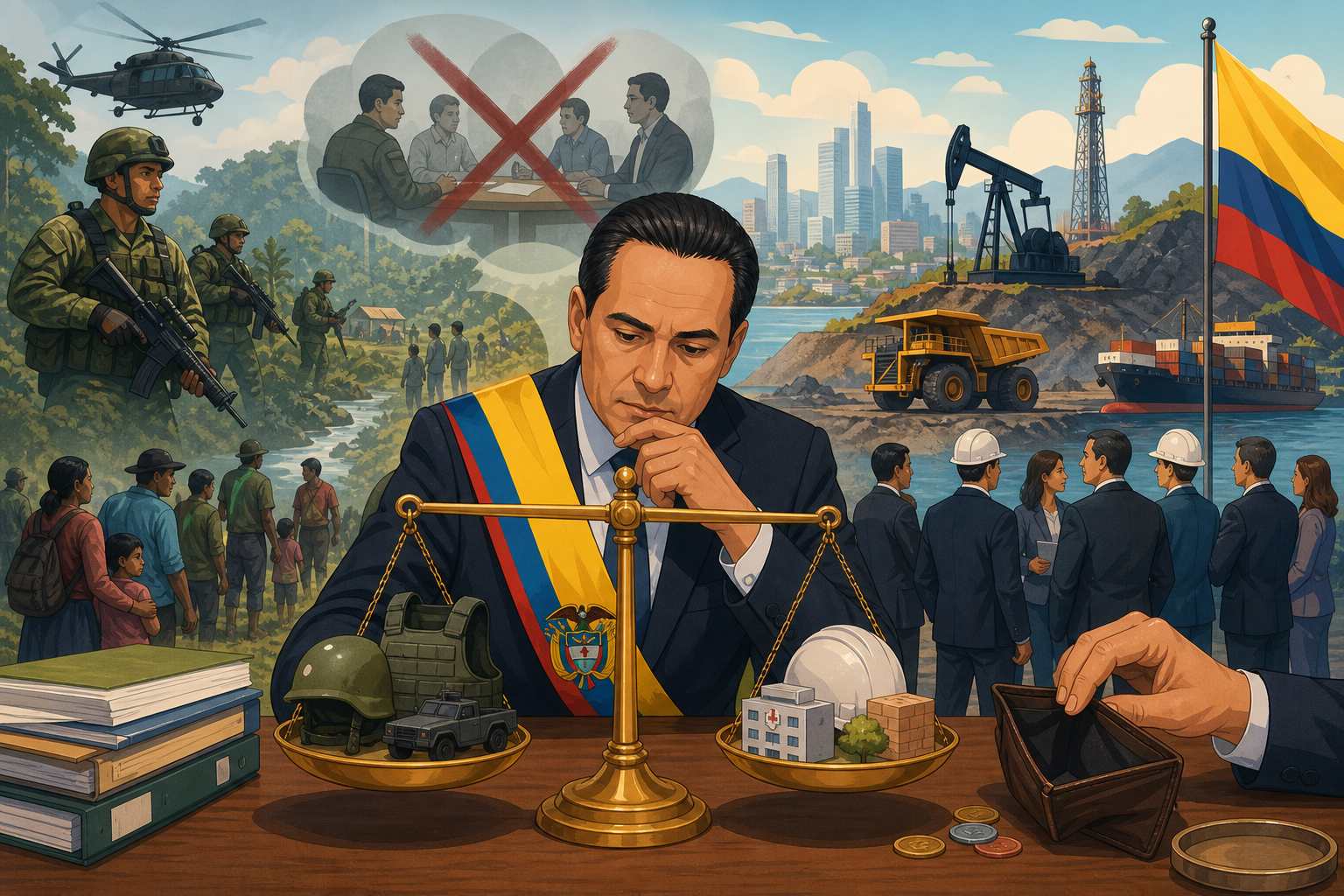

Colombia's new president inherited a fiscal straitjacket on Friday that may not accommodate the security buildup he campaigned on. Abelardo de la Espriella's inauguration rhetoric promised military expansion, enhanced policing, and the end of negotiated peace with armed groups. The budget he now controls does not have room for all three.
The arithmetic is straightforward. Colombia's Regla Fiscal, the spending cap written into law after years of debt accumulation, limits how much the government can expand outlays in any given year. The Ministry of Finance projects revenue growth of roughly 2.5% in real terms for 2026 and 2027. Defense and security already consume nearly 17% of the national budget. A meaningful escalation in military presence across rural departments like Cauca and Nariño, where ELN and EMC factions maintain territorial control, would require adding personnel, building infrastructure, and sustaining operations in regions where the state has little logistical footprint. None of that is cheap.
De la Espriella's campaign did not dwell on these constraints. His messaging centered on dismantling what he called Petro's "surrender diplomacy," the Total Peace framework that sought negotiated settlements with illegal armed groups. The new administration frames security as a matter of will, not resources. Speaking to crowds in Bogotá and Medellín during the campaign, De la Espriella repeated a simple claim: previous governments failed because they negotiated instead of confronting. The applause suggested voters agreed.
Where the money would need to come from
Three buckets of spending are in theoretical play. The first is reallocation within the existing defense budget, shifting funds away from administration and into field operations. The Defensoría del Pueblo has documented sustained armed-group presence in over 300 municipalities, many of which see a military patrol once a month or less. Meaningful coverage would require triple the current deployment rate, which in turn requires hiring soldiers, buying vehicles, and maintaining supply lines. Internal reallocation might fund the first six months. After that, the numbers stop adding up.
The second option is cutting social programs to free fiscal space. Petro's government expanded health subsidies and pension access for informal workers, programs that now account for a growing share of mandatory spending. Rolling those back would generate savings, but it would also break campaign promises De la Espriella made to working-class voters outside the major cities. A president who won on security but presides over collapsing rural health clinics would face a different kind of political crisis.
The third is violating the fiscal rule. Emergency powers allow temporary exemptions, and other Latin American governments have used security threats as justification for exceeding spending caps. The risk is market reaction. Colombia's sovereign bonds trade on investor confidence that the fiscal framework holds. A sustained breach would likely trigger capital flight and currency depreciation, the same instability that weakened the Petro administration in its final year.
The Bukele example doesn't translate
De la Espriella has cited El Salvador's Nayib Bukele as a model. Bukele deployed emergency detention powers and flooded gang-controlled neighborhoods with soldiers. Homicide rates dropped. What the comparison omits is scale. El Salvador's total population is 6.3 million. Colombia's is 52 million, spread across topography that includes the Andes, the Amazon basin, and two coastlines. Bukele's mass-incarceration model worked in a country the size of a single Colombian department. Replicating it nationally would require building detention capacity that does not exist and cannot be funded under current budget math.
The new president's legal background may shape how this plays out. As a defense attorney, De la Espriella built a career on high-stakes performance and procedural maneuvering. Governance operates under different rules. The legislature is fragmented. The Constitutional Court reviews emergency decrees. The budget does not expand because the president insists it should. De la Espriella promised voters total victory over organized crime. The balance sheet he now controls offers him partial funding and hard choices.
Read Next
How to Eliminate Bridge Financing by Controlling Your Closing Dates
How to position your portfolio for a decade of below-average stock market returns
The Government's 'Productivity Deduction' Is a Rebrand, Not a Reform
Pay Down Your House Before Your Rental: The Tax Math Real Estate Investors Miss