Canada's Housing Fix Requires $1.7 Trillion and Higher Rates for a Decade
A 35-year-old software engineer in Toronto earning $110,000 can't afford the median condo in her own city. That's not a borrowing problem or a savings problem. It's a supply problem so severe that fixing it will reshape the entire Canadian economy for the rest of her working life.
Desjardins Economics pegs the bill at $1.7 trillion over ten years. That's not a government budget line. It's the total private and public capital required to build the 3.5 million additional housing units CMHC says Canada needs to restore anything resembling affordability by 2030. To hit that target, residential construction investment must double from current levels. Not grow. Double.
The arithmetic creates a funding collision nobody in Ottawa wants to name. $1.7 trillion in borrowed capital doesn't sit quietly in one sector. It competes. Infrastructure upgrades, grid modernization, industrial decarbonization, and every other macro-scale project in the national pipeline will be bidding for the same pool of investment dollars. When demand for credit runs that high for that long, the price of credit stays elevated. The interest rate floor everyone keeps waiting to collapse? It's structural now, not cyclical.
Why Throwing Money at This Might Not Work
Doubling investment assumes the construction industry can absorb it. It can't. Canada has roughly 1.4 million people working in construction trades, and a significant portion are within a decade of retirement. More capital chasing the same number of skilled electricians, plumbers, and framers doesn't produce more housing. It produces wage inflation, which feeds back into construction costs, which makes the $1.7 trillion insufficient before the decade is half over.
This is the part where someone counters with immigration. Fine. But the selection system would need a hard pivot toward trades certification, and even then, ticket recognition across provinces remains a bureaucratic snarl. The scenario where Canada trains or imports enough skilled labor to double output in ten years requires policy changes that haven't been proposed, let alone implemented.
The Productivity Sacrifice Nobody's Pricing
Here's the second-order cost: $1.7 trillion sunk into residential real estate is $1.7 trillion not funding R&D, automation, or export-competitive manufacturing. Housing is necessary infrastructure, but it's non-productive capital in the GDP sense. You can't sell a condo to Germany. The trade-off is real. An economy that spends a decade pouring investment into shelter is an economy that isn't spending that decade building the next generation of competitive advantage.
The FIRE crowd will argue that housing is a wealth store and therefore productive. It isn't. It's a positional good. If every house in Canada doubled in value tomorrow, the country wouldn't be richer. The pie would just be repriced. Real wealth comes from making things other people want to buy. Housing consumes capital. It doesn't generate it.
The Rate Trap
The Bank of Canada has spent two years trying to bring inflation back to 2% so it can cut rates and stimulate growth. But if the construction surge begins in earnest, the demand for borrowed capital will keep upward pressure on yields regardless of what the policy rate does. Developers financing projects at 4.5% to 5% can't deliver affordable units. The math doesn't close. Which means either the units don't get built, or they get built and sold at prices that don't solve the affordability problem the $1.7 trillion was supposed to fix.
We're looking at a decade where rates stay elevated, housing starts double, and the median buyer still can't afford the median house because the new supply gets scooped by investors and high-net-worth households faster than first-timers can qualify. The $1.7 trillion builds the units. It doesn't guarantee they go to the people who need them.


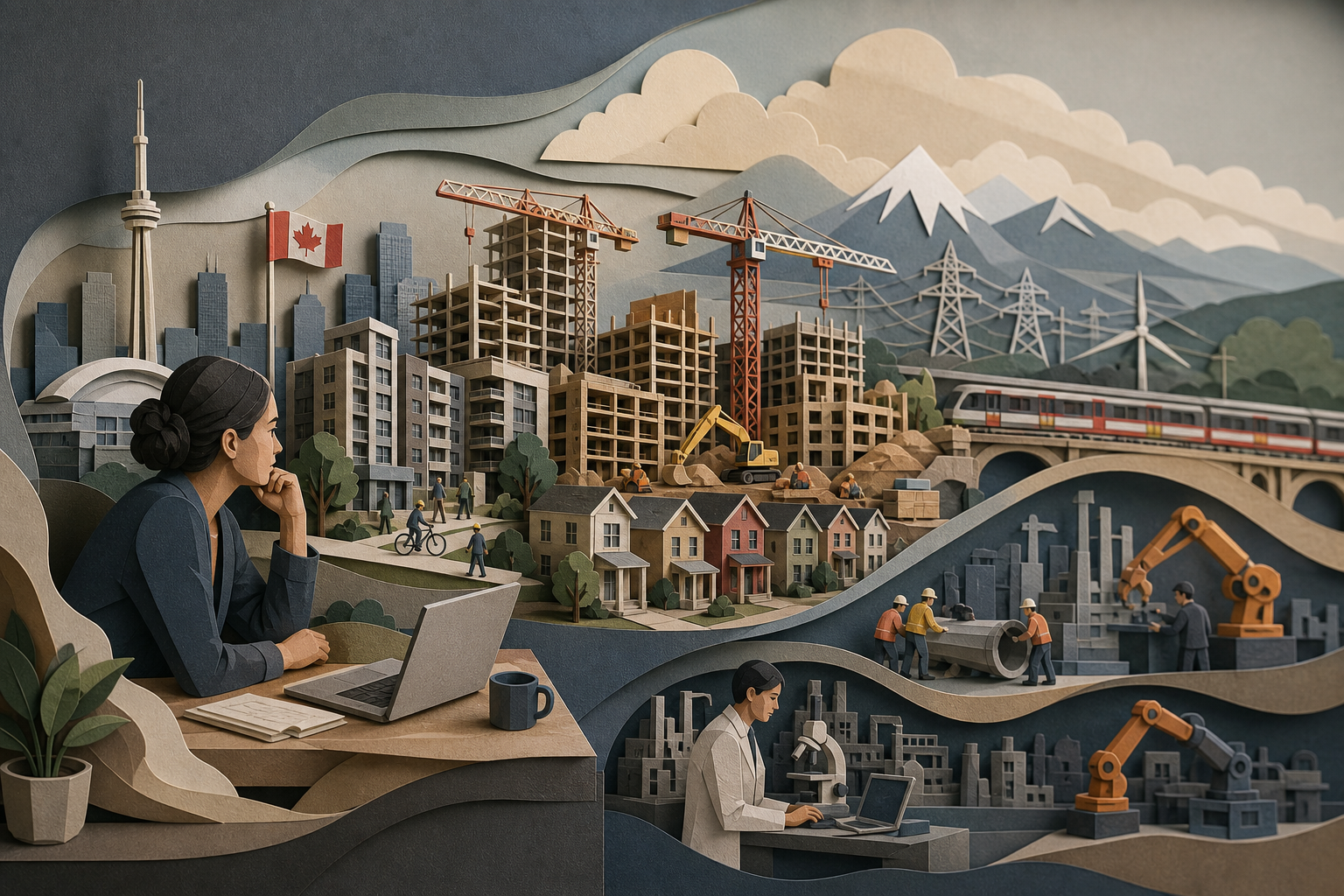

A 35-year-old software engineer in Toronto earning $110,000 can't afford the median condo in her own city. That's not a borrowing problem or a savings problem. It's a supply problem so severe that fixing it will reshape the entire Canadian economy for the rest of her working life.
Desjardins Economics pegs the bill at $1.7 trillion over ten years. That's not a government budget line. It's the total private and public capital required to build the 3.5 million additional housing units CMHC says Canada needs to restore anything resembling affordability by 2030. To hit that target, residential construction investment must double from current levels. Not grow. Double.
The arithmetic creates a funding collision nobody in Ottawa wants to name. $1.7 trillion in borrowed capital doesn't sit quietly in one sector. It competes. Infrastructure upgrades, grid modernization, industrial decarbonization, and every other macro-scale project in the national pipeline will be bidding for the same pool of investment dollars. When demand for credit runs that high for that long, the price of credit stays elevated. The interest rate floor everyone keeps waiting to collapse? It's structural now, not cyclical.
Why Throwing Money at This Might Not Work
Doubling investment assumes the construction industry can absorb it. It can't. Canada has roughly 1.4 million people working in construction trades, and a significant portion are within a decade of retirement. More capital chasing the same number of skilled electricians, plumbers, and framers doesn't produce more housing. It produces wage inflation, which feeds back into construction costs, which makes the $1.7 trillion insufficient before the decade is half over.
This is the part where someone counters with immigration. Fine. But the selection system would need a hard pivot toward trades certification, and even then, ticket recognition across provinces remains a bureaucratic snarl. The scenario where Canada trains or imports enough skilled labor to double output in ten years requires policy changes that haven't been proposed, let alone implemented.
The Productivity Sacrifice Nobody's Pricing
Here's the second-order cost: $1.7 trillion sunk into residential real estate is $1.7 trillion not funding R&D, automation, or export-competitive manufacturing. Housing is necessary infrastructure, but it's non-productive capital in the GDP sense. You can't sell a condo to Germany. The trade-off is real. An economy that spends a decade pouring investment into shelter is an economy that isn't spending that decade building the next generation of competitive advantage.
The FIRE crowd will argue that housing is a wealth store and therefore productive. It isn't. It's a positional good. If every house in Canada doubled in value tomorrow, the country wouldn't be richer. The pie would just be repriced. Real wealth comes from making things other people want to buy. Housing consumes capital. It doesn't generate it.
The Rate Trap
The Bank of Canada has spent two years trying to bring inflation back to 2% so it can cut rates and stimulate growth. But if the construction surge begins in earnest, the demand for borrowed capital will keep upward pressure on yields regardless of what the policy rate does. Developers financing projects at 4.5% to 5% can't deliver affordable units. The math doesn't close. Which means either the units don't get built, or they get built and sold at prices that don't solve the affordability problem the $1.7 trillion was supposed to fix.
We're looking at a decade where rates stay elevated, housing starts double, and the median buyer still can't afford the median house because the new supply gets scooped by investors and high-net-worth households faster than first-timers can qualify. The $1.7 trillion builds the units. It doesn't guarantee they go to the people who need them.
Read Next
How to Eliminate Bridge Financing by Controlling Your Closing Dates
How to position your portfolio for a decade of below-average stock market returns
The Government's 'Productivity Deduction' Is a Rebrand, Not a Reform
Pay Down Your House Before Your Rental: The Tax Math Real Estate Investors Miss