Bank of Canada Holds Rates at 2.25% While Trade War Removes All Other Options
Bank of Canada Holds Rates at 2.25% While Trade War Removes All Other Options
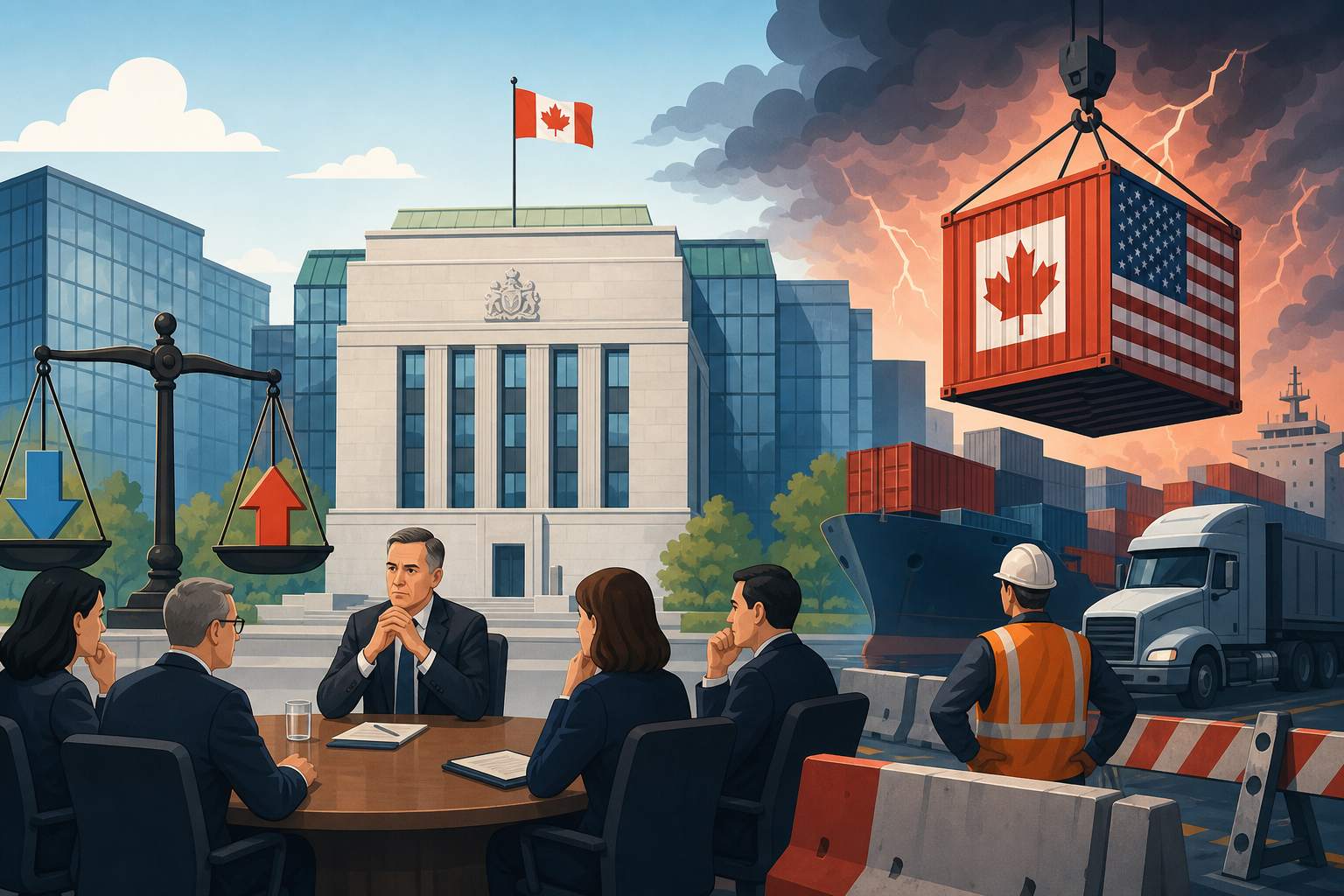
The September decision was set before the tariffs started. By the time President Trump imposed a 50% levy on Canadian steel and aluminum under Section 232, the Governing Council's menu had already shrunk to one item. Hold.
Not because the domestic economy warranted it. Because moving either direction became impossible to price.
The Neutral Rate Used to Be a Range
The Bank of Canada's neutral rate range, the band where policy neither stimulates nor restrains growth, sits between 2.25% and 3.25%. At 2.25%, the overnight rate sits at the bottom of that range. That position leaves the bank with clear room to raise rates if inflation runs, but limited space to cut further without signaling that policy has moved into stimulative territory.
Trade wars don't care about your range. They care about supply chains, border delays, and whether a manufacturer in Oshawa can still ship transmissions to Michigan without the math falling apart. Tariffs act as a tax on consumers, which sounds inflationary. The slowdown they cause is deflationary. You can't model that in advance. You can only watch it happen.
So the bank holds, even when the data might otherwise argue for movement. Forward guidance becomes "we're watching closely," which is central bank code for "we don't know either."
The Mortgage Cliff Still Matters More Than the Headlines
Close to one in five Canadian jobs ties back to exports, most of them to the U.S. Cross-border goods trade runs $3.6 billion CAD daily. A prolonged tariff fight hammers specific sectors, manufacturing in Ontario, forestry in British Columbia, agriculture on the Prairies, but interest rates are a blunt instrument. They hit everyone.
What hits everyone harder right now is the mortgage renewal wave. Millions of fixed-rate mortgages locked in during 2020 and 2021 at rates under 2% are coming due through 2025 and 2026. The household that borrowed $500,000 at 1.79% in March 2021 faces a monthly payment jump of roughly $900 when they renew at 5.4%. That's $10,800 a year with no increase in living space, no new amenities, no additional value. Just the cost of time.
The bank can't hike into that without tipping households into forced sales. It can't cut aggressively without signaling panic over the trade war, which would spook business investment further. The middle ground isn't a choice. It's the last square left on the board.
The Inflation Target Becomes a Political Anchor
The Bank of Canada's primary mandate is inflation control, targeting a 2% midpoint. That mandate gives the Governing Council its credibility. It also boxes them in. If tariff-induced price shocks push inflation above 2.5%, the textbook move is to tighten. If the resulting economic contraction drives unemployment above 6%, the textbook move is to ease.
A trade war delivers both at once. Stagflation risk.
The bank's advantage, the only one it has left, is that it didn't panic in response to every headline over the past eighteen months. By holding through the early escalation, it preserved the perception of stability. Markets and households anchored to the 2.25% rate as a psychological floor. Moving now would cost that anchor, and getting it back takes years.
What "Wait and See" Actually Costs
The safety-in-stasis strategy isn't free. Holding rates steady when parts of the economy are already contracting means some regions absorb deeper losses than others. The bank doesn't have regional policy tools. Ontario manufacturing and Prairie agriculture take the hit while the national rate reflects a national average that doesn't describe anyone's actual conditions.
The longer the trade war runs, the more that gap matters. A hold that made sense in September might look like inertia by December. But the alternative, cutting rates preemptively to soften a tariff-driven slowdown, would signal that the bank believes the damage is permanent. That's not a message you send unless you're certain. And nobody's certain.
So they hold. Not because it's optimal. Because it's the only move that doesn't make things demonstrably worse.



Bank of Canada Holds Rates at 2.25% While Trade War Removes All Other Options
The September decision was set before the tariffs started. By the time President Trump imposed a 50% levy on Canadian steel and aluminum under Section 232, the Governing Council's menu had already shrunk to one item. Hold.
Not because the domestic economy warranted it. Because moving either direction became impossible to price.
The Neutral Rate Used to Be a Range
The Bank of Canada's neutral rate range, the band where policy neither stimulates nor restrains growth, sits between 2.25% and 3.25%. At 2.25%, the overnight rate sits at the bottom of that range. That position leaves the bank with clear room to raise rates if inflation runs, but limited space to cut further without signaling that policy has moved into stimulative territory.
Trade wars don't care about your range. They care about supply chains, border delays, and whether a manufacturer in Oshawa can still ship transmissions to Michigan without the math falling apart. Tariffs act as a tax on consumers, which sounds inflationary. The slowdown they cause is deflationary. You can't model that in advance. You can only watch it happen.
So the bank holds, even when the data might otherwise argue for movement. Forward guidance becomes "we're watching closely," which is central bank code for "we don't know either."
The Mortgage Cliff Still Matters More Than the Headlines
Close to one in five Canadian jobs ties back to exports, most of them to the U.S. Cross-border goods trade runs $3.6 billion CAD daily. A prolonged tariff fight hammers specific sectors, manufacturing in Ontario, forestry in British Columbia, agriculture on the Prairies, but interest rates are a blunt instrument. They hit everyone.
What hits everyone harder right now is the mortgage renewal wave. Millions of fixed-rate mortgages locked in during 2020 and 2021 at rates under 2% are coming due through 2025 and 2026. The household that borrowed $500,000 at 1.79% in March 2021 faces a monthly payment jump of roughly $900 when they renew at 5.4%. That's $10,800 a year with no increase in living space, no new amenities, no additional value. Just the cost of time.
The bank can't hike into that without tipping households into forced sales. It can't cut aggressively without signaling panic over the trade war, which would spook business investment further. The middle ground isn't a choice. It's the last square left on the board.
The Inflation Target Becomes a Political Anchor
The Bank of Canada's primary mandate is inflation control, targeting a 2% midpoint. That mandate gives the Governing Council its credibility. It also boxes them in. If tariff-induced price shocks push inflation above 2.5%, the textbook move is to tighten. If the resulting economic contraction drives unemployment above 6%, the textbook move is to ease.
A trade war delivers both at once. Stagflation risk.
The bank's advantage, the only one it has left, is that it didn't panic in response to every headline over the past eighteen months. By holding through the early escalation, it preserved the perception of stability. Markets and households anchored to the 2.25% rate as a psychological floor. Moving now would cost that anchor, and getting it back takes years.
What "Wait and See" Actually Costs
The safety-in-stasis strategy isn't free. Holding rates steady when parts of the economy are already contracting means some regions absorb deeper losses than others. The bank doesn't have regional policy tools. Ontario manufacturing and Prairie agriculture take the hit while the national rate reflects a national average that doesn't describe anyone's actual conditions.
The longer the trade war runs, the more that gap matters. A hold that made sense in September might look like inertia by December. But the alternative, cutting rates preemptively to soften a tariff-driven slowdown, would signal that the bank believes the damage is permanent. That's not a message you send unless you're certain. And nobody's certain.
So they hold. Not because it's optimal. Because it's the only move that doesn't make things demonstrably worse.
Sources
Read Next
Pay Down Your House Before Your Rental: The Tax Math Real Estate Investors Miss
The OAS Clawback Is 15 Cents Per Dollar, Not 30 or 50
7 streaming services worth paying for in Canada, plus the credit cards that cut your bill
Ontario and B.C. First-Time Buyers Are Borrowing in Pairs, and the Cracks Are Starting to Show