25 States Sue Trump Over Tariffs, Claiming He Lacks Legal Authority to Tax Imports
California, New York, and 23 other states filed suit in federal court last week, claiming the president cannot impose what effectively amounts to a 10-to-25-percent sales tax on imported goods without a direct grant of congressional authority. The complaint argues that the 2026 tariff orders, covering steel, aluminum, semiconductors, and consumer electronics from Canada, Mexico, and China, exceed the narrow delegation Congress intended when it passed the Trade Expansion Act of 1962.
The Constitutional Claim
The lawsuit rests on Article I, Section 8 of the Constitution, which grants Congress alone the power to "lay and collect Taxes, Duties, Imposts and Excises." The states argue that while Congress may delegate certain foreign policy tools to the executive branch, it cannot hand over the tax power wholesale. The 1962 Act permits the president to adjust tariffs in response to national security threats under Section 232. The plaintiffs claim importing mid-range laptops from Shenzhen does not meet that standard.
Legal precedent favors executive discretion here. Courts have historically declined to second-guess what counts as a "security threat," granting presidents wide latitude when they invoke the phrase. The states are betting that the sheer breadth of the tariff orders, covering roughly $340 billion in annual imports, will force the judiciary to draw a line it has avoided drawing for 60 years.
The Economic Argument
State budget offices in the coalition estimate the tariffs will increase infrastructure costs by $4.7 billion annually. Illinois projects a 14-percent rise in the cost of upgrading transit systems that rely on imported rail components. New York calculates that public schools will pay 18 percent more for Chromebooks and other classroom technology sourced overseas. These are not abstract harms. They translate into fewer miles of repaved highway, delayed building retrofits, and either higher state taxes or cuts to other services.
The administration counters that short-term cost increases are the price of long-term supply chain sovereignty. Domestic steel producers argue the tariffs have already reversed a decade of plant closures and brought back 11,000 manufacturing jobs since January 2026. The states filing suit are concentrated in service economies and coastal regions where the consumer cost is felt immediately. States with heavy manufacturing bases, Pennsylvania, Ohio, Indiana, are not plaintiffs. The lawsuit is as much a map of economic structure as a constitutional objection.
The Standing Problem
For the case to proceed, the states must prove they are injured parties, not just policy critics. The Department of Justice will argue that rising costs for state procurement do not constitute the kind of direct, concrete harm required for standing. States routinely face higher costs when federal policy changes, fuel standards, labor rules, environmental mandates, and courts do not grant them veto power over those policies through litigation.
The plaintiff states are framing the harm narrowly: lost tax revenue from businesses hurt by input cost increases, measurable budget shortfalls from higher infrastructure spending, and identifiable job losses in import-dependent sectors. If the court accepts this reasoning, the case moves forward. If not, the suit ends at the threshold.
This case forces the Supreme Court to choose between two principles it has historically protected: deference to the executive on matters touching national security, and strict limits on delegated legislative power. The administration will invoke the first. The states are betting the second is stronger when the power in question is taxation itself.


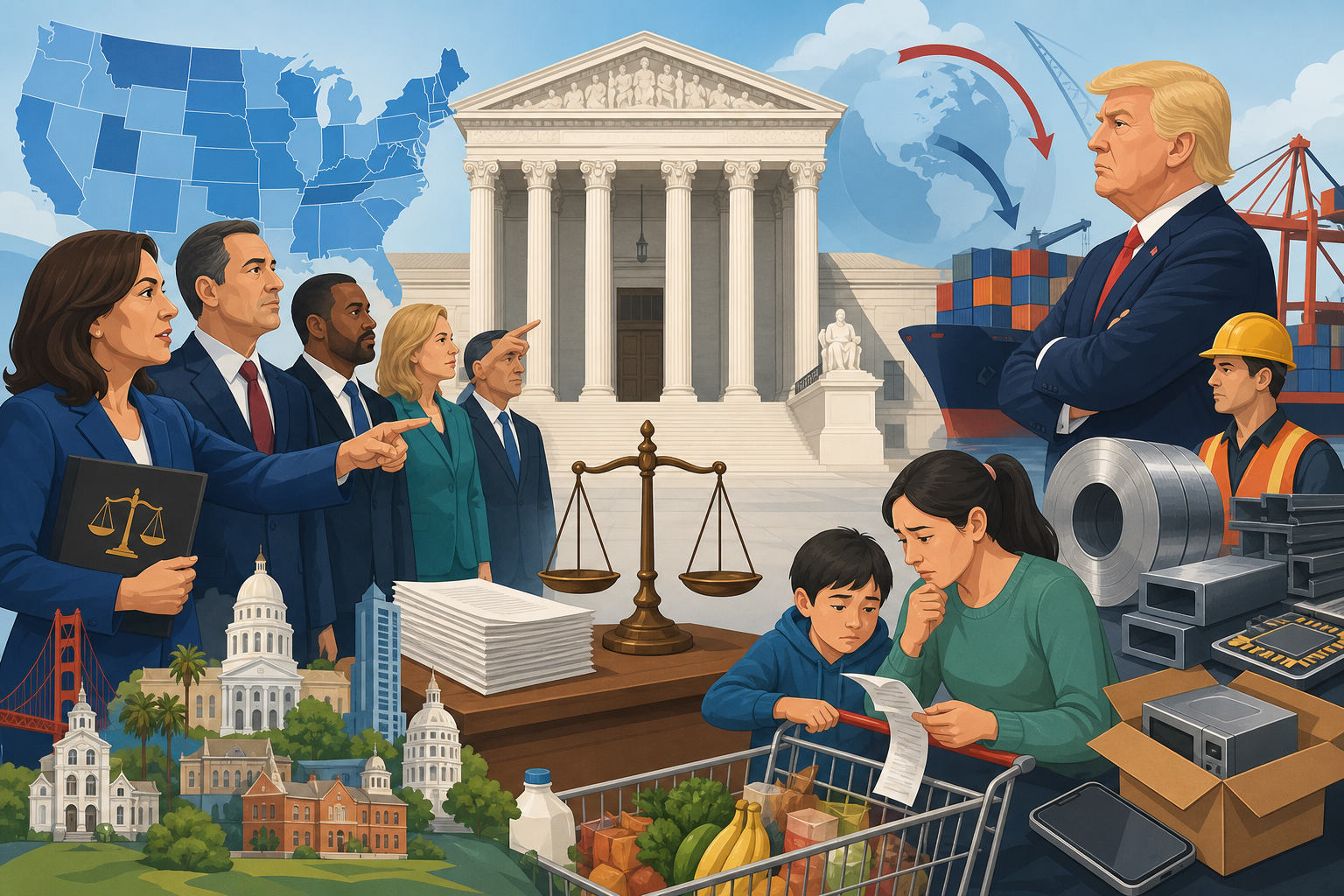

California, New York, and 23 other states filed suit in federal court last week, claiming the president cannot impose what effectively amounts to a 10-to-25-percent sales tax on imported goods without a direct grant of congressional authority. The complaint argues that the 2026 tariff orders, covering steel, aluminum, semiconductors, and consumer electronics from Canada, Mexico, and China, exceed the narrow delegation Congress intended when it passed the Trade Expansion Act of 1962.
The Constitutional Claim
The lawsuit rests on Article I, Section 8 of the Constitution, which grants Congress alone the power to "lay and collect Taxes, Duties, Imposts and Excises." The states argue that while Congress may delegate certain foreign policy tools to the executive branch, it cannot hand over the tax power wholesale. The 1962 Act permits the president to adjust tariffs in response to national security threats under Section 232. The plaintiffs claim importing mid-range laptops from Shenzhen does not meet that standard.
Legal precedent favors executive discretion here. Courts have historically declined to second-guess what counts as a "security threat," granting presidents wide latitude when they invoke the phrase. The states are betting that the sheer breadth of the tariff orders, covering roughly $340 billion in annual imports, will force the judiciary to draw a line it has avoided drawing for 60 years.
The Economic Argument
State budget offices in the coalition estimate the tariffs will increase infrastructure costs by $4.7 billion annually. Illinois projects a 14-percent rise in the cost of upgrading transit systems that rely on imported rail components. New York calculates that public schools will pay 18 percent more for Chromebooks and other classroom technology sourced overseas. These are not abstract harms. They translate into fewer miles of repaved highway, delayed building retrofits, and either higher state taxes or cuts to other services.
The administration counters that short-term cost increases are the price of long-term supply chain sovereignty. Domestic steel producers argue the tariffs have already reversed a decade of plant closures and brought back 11,000 manufacturing jobs since January 2026. The states filing suit are concentrated in service economies and coastal regions where the consumer cost is felt immediately. States with heavy manufacturing bases, Pennsylvania, Ohio, Indiana, are not plaintiffs. The lawsuit is as much a map of economic structure as a constitutional objection.
The Standing Problem
For the case to proceed, the states must prove they are injured parties, not just policy critics. The Department of Justice will argue that rising costs for state procurement do not constitute the kind of direct, concrete harm required for standing. States routinely face higher costs when federal policy changes, fuel standards, labor rules, environmental mandates, and courts do not grant them veto power over those policies through litigation.
The plaintiff states are framing the harm narrowly: lost tax revenue from businesses hurt by input cost increases, measurable budget shortfalls from higher infrastructure spending, and identifiable job losses in import-dependent sectors. If the court accepts this reasoning, the case moves forward. If not, the suit ends at the threshold.
This case forces the Supreme Court to choose between two principles it has historically protected: deference to the executive on matters touching national security, and strict limits on delegated legislative power. The administration will invoke the first. The states are betting the second is stronger when the power in question is taxation itself.
Read Next
How to Eliminate Bridge Financing by Controlling Your Closing Dates
How to position your portfolio for a decade of below-average stock market returns
The Government's 'Productivity Deduction' Is a Rebrand, Not a Reform
Pay Down Your House Before Your Rental: The Tax Math Real Estate Investors Miss